

Quick answer
Fairbanks northern lights prediction relies on the University of Alaska Geophysical Institute's real-time aurora forecast, updated every fifteen minutes at gi.alaska.edu/monitors/aurora-forecast. The forecast uses Kp index values (planetary geomagnetic activity) and local cloud cover data to predict visibility windows. A Kp of 2 or higher typically produces visible aurora in Fairbanks, with peak activity occurring between 22:00 and 02:00 when the auroral oval aligns with Interior Alaska's magnetic latitude.
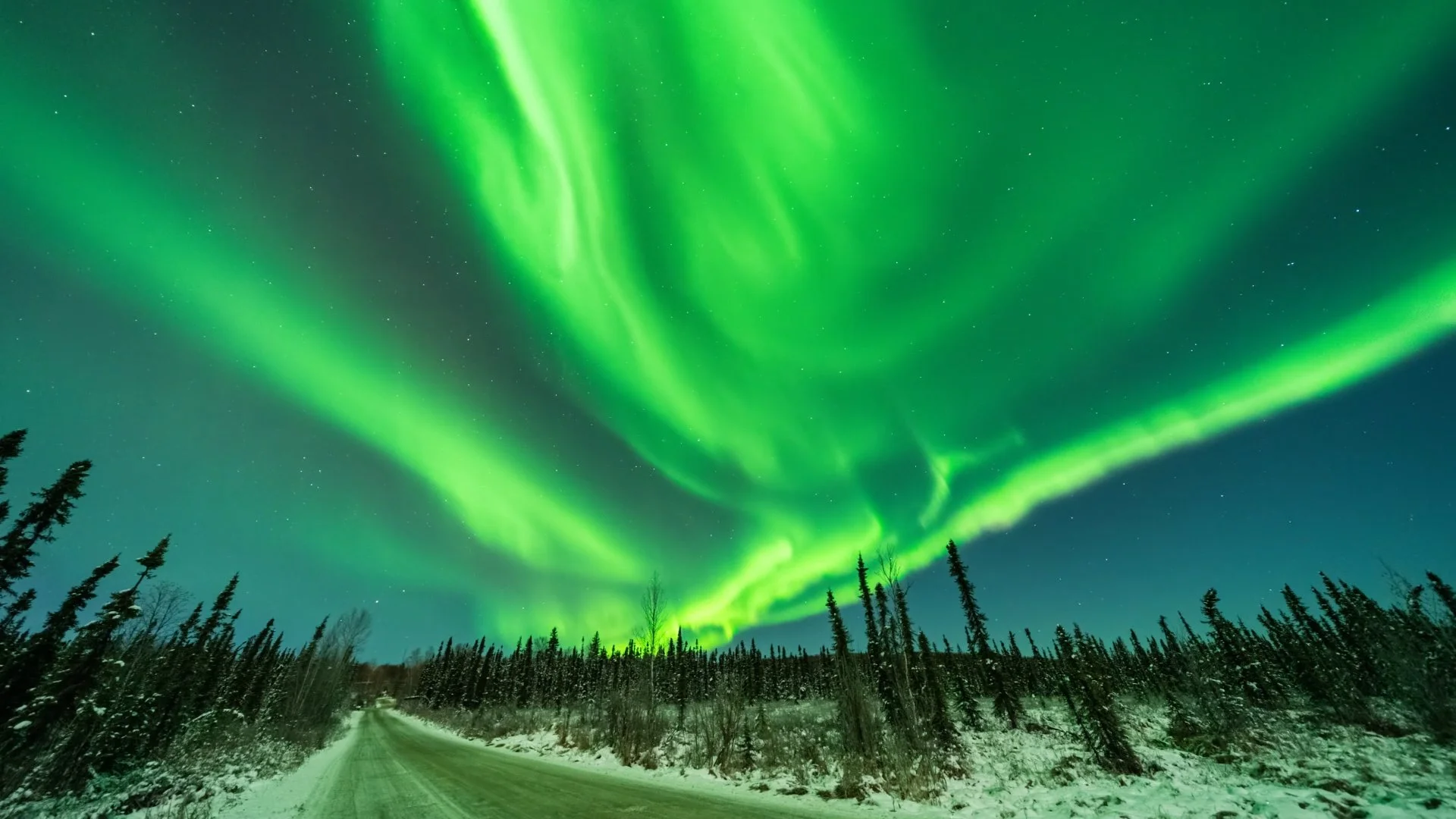
The Geophysical Institute at the University of Alaska Fairbanks operates the most precise aurora forecasting system for Interior Alaska, processing solar wind data from NASA's ACE satellite positioned 1.5 million kilometers upstream of Earth. That thirty-minute lead time between solar wind detection and atmospheric impact allows the Institute to issue rolling predictions throughout each night, mapping the auroral oval's position relative to Fairbanks in real time. Kp index readings measure global geomagnetic disturbance on a zero-to-nine scale, but Fairbanks sits far enough north that even modest activity registers overhead. A Kp of 1 produces faint aurora on the northern horizon; Kp 2 brings visible bands across the sky; Kp 4 or higher delivers the vivid curtains and coronas that dominate the entire dome. The forecast overlays local cloud cover from NOAA satellites, filtering out nights when atmospheric conditions would block visibility regardless of geomagnetic strength. Prediction accuracy degrades beyond a three-hour window because solar wind speed fluctuates and coronal mass ejections arrive unpredictably. Checking the forecast after 20:00 gives you the most reliable read for that night's activity, with updates every fifteen minutes as new satellite data arrives. The oval's geometry favors Fairbanks during equinox months when Earth's magnetic field tilts toward the solar wind stream, but strong storms produce aurora year-round. Mobile apps repackage the Geophysical Institute's data with notification thresholds, but the source remains the same. The Institute's web interface displays auroral activity as a green intensity map over Alaska, with Fairbanks marked at the center. When the green zone expands southward over the city's latitude, visibility becomes likely if skies remain clear. Cloud forecasts for Fairbanks appear on the same page, condensing both variables into a single decision point—whether to drive out of town or stay indoors.
“A Kp of 2 or higher typically produces visible aurora in Fairbanks, with the auroral oval aligning directly overhead during equinox months.”
Optimal Timing for Fairbanks Northern Lights Prediction
The prime season for viewing the aurora in Fairbanks spans from late August to April. During these months, the best arrival window is 22:00–02:00 to maximize visibility during peak darkness hours.
Late August–September
Low crowdsCool, 40°F to 55°F
Darker skies return as daylight hours decrease. Early season allows for milder temperatures while viewing.
October–March
Moderate crowdsCold, -20°F to 20°F
Extended darkness provides the highest frequency of sightings. Consistent cold weather ensures clear skies if storms are absent.
April
Low crowdsCold, 10°F to 35°F
Daylight increases rapidly, shortening the available viewing window. This period marks the final reliable opportunity before the summer sun.
Verdict: The most favorable period is between late August and April, specifically arriving nightly during the 22:00–02:00 window.
Viewing Hours for Fairbanks Northern Lights Prediction
The northern lights are a naturally occurring phenomenon visible whenever darkness and solar activity align. Observation is possible at any time, as the display depends on atmospheric conditions rather than scheduled access.
| Monday | 00:00–23:59 | |
|---|---|---|
| Tuesday | 00:00–23:59 | |
| Wednesday | 00:00–23:59 | |
| Thursday | 00:00–23:59 | |
| Friday | 00:00–23:59 | |
| Saturday | 00:00–23:59 | |
| Sunday | 00:00–23:59 |
Essential Preparation for Fairbanks Northern Lights Prediction
Successful aurora viewing in Fairbanks requires cold-weather preparation, reliable forecast monitoring, and appropriate camera equipment.
-
Download aurora forecast apps — Real-time Kp-index and cloud-cover data improve timing decisions.
-
Pack insulated clothing and hand warmers — Temperatures commonly drop below -20°F during winter viewing hours.
-
Bring a DSLR or mirrorless camera — Long exposures (15-30 seconds) at high ISO capture auroral displays manual cameras cannot.
-
Set manual focus to infinity — Autofocus fails in low light; pre-focus ensures sharp aurora shots.
-
Charge backup batteries and keep warm — Cold rapidly drains lithium-ion cells; store spares inside your jacket.
-
Scout dark locations away from city lights — Light pollution from Fairbanks reduces contrast and visibility of fainter auroral bands.
-
Monitor the official UAF Geophysical Institute forecast — https://www.gi.alaska.edu/monitors/aurora-forecast provides the most accurate regional predictions.
Scientific Context for Fairbanks Northern Lights Prediction
The aurora borealis results from solar particles colliding with gases in Earth's atmosphere. Scientific forecasting relies on monitoring solar wind speed, density, and geomagnetic activity to predict these displays.
100 kilometers altitude
The aurora typically occurs in the thermosphere, where solar particles interact with oxygen and nitrogen atoms. This altitude is roughly 62 miles above the Earth's surface.
60 degrees latitude
Fairbanks sits at approximately 65 degrees North latitude, placing it directly under the auroral oval. This region experiences frequent geomagnetic activity due to its proximity to the magnetic pole.
Solar wind velocity
The Geophysical Institute uses data on solar wind speed to estimate arrival times of coronal mass ejections. Higher velocities often correlate with more intense geomagnetic storms.
Oxygen emission colors
Collisions with oxygen molecules at different altitudes produce distinct green and red light emissions. Green is the most common color observed during high-activity nights.
Nitrogen emission colors
When solar particles collide with nitrogen atoms, they often produce blue or purple hues. These colors are frequently visible during periods of high solar activity.
Geomagnetic Kp-index
The Kp-index measures disturbances in Earth's magnetic field on a scale from 0 to 9. Higher values indicate a wider and more active auroral oval visible from lower latitudes.
Solar cycle influence
The sun follows an approximately 11-year cycle of magnetic activity. During solar maximum, the frequency and intensity of auroral displays generally increase.
Check availability
Frequently asked questions about fairbanks northern lights prediction
Everything you need to know about fairbanks northern lights prediction